Showing posts with label facebook. Show all posts

5 Tech Predictions for 2013


Zimedia's 5 Tech Predictions for 2013


5. Second Screen takes off – The second screen takes on the big screen.

The second screen is taking over. Users are splitting their time between the main screen and a second screen – companion devices and apps. For live shows, users turn to Twitter. For movies and streaming content, users stick to GetGlue to check-in and provide live commentary. (If you're into streaming video like Netflix and Hulu Plus, you'll want to check out GetGlue.) In November, GetGlue was acquired by TV-loyalty service Viggle for $25 million in cash and 48 million shares.

AirPlay-like devices also allow users to stream media from a tablet or smartphone wirelessly to a television set. It opens up content from apps or the web and makes it playable on a user's TV. Apple AirPlay on Apple TV is one of the first and best. More are on the way in 2013.

4. Facebook loses market share– due in large part to audience fragmentation.

Facebook has an enormous lead when it comes to audience share among social networks because it's always one step ahead of the competition. The same changes that infuriate some users are the ones that keep others wanting more. MySpace lost users because it was stagnant. Facebook doesn't want to suffer the same fate.

But users will begin to explore other options in 2013, including LinkedIn, Google+, Foursquare, Path and others, all of which have adopted the "Newsfeed" layout. Users will spend more time on these sites, which means less time spent on Facebook. Foursquare, for example, has de-emphasized its leaderboard and put more focus on the newsfeed and its "Explore" feature. 

3. Mobile Payments become mainstream –  Square launched in 7,000 Starbucks coffee houses in November of 2012. Today, Square is processing $10 billion in annual mobile payments. In 2013 mobile payments will become mainstream.

Joining Square in the mobile payment race are competitors Google Wallet, PayPal, Intuit, Visa, Mastercard, American Express, VeriFone, among others.

2. Free city-wide Internet – Public Wi-Fi gets closer to the streets in 2013. Already available at many restaurants and stores, more hotspots are on the way. 

But more than just hotspots: Google has been working on a city-wide Wi-Fi network for some time, with the first attempt around 2007. It's Google Fiber project seems to have taken the spotlight, as the company rolled out the high-speed broadband network in Kansas City, Missouri, in 2012. 

We feel like now is the time to break some ground on city-wide Wi-Fi. 

The Tel Aviv municipality announced in December of 2012 that it would be deploying a city-wide Wi-Fi network in Israel, headed by Motorola Solutions, that includes 80 relay stations for free wireless access. Watch for a similar service to hit the United States in 2013.


1. Big Netflix Competitor– We predicted it for 2012. Redbox Instant by Verizon launched in Beta in December of 2012. Could it be the Next Netflix? Others are rumored to be teaming up for a service. Amazon Instant Video is gaining steam, though is part of a much larger plan for Amazon. It will take a lot of financial backing which is why we’ll likely see businesses teaming up on this one. Hulu is handcuffed by its owners (Comcast's NBCUniversal, Disney and News Corp.).

Whether it’s Redbox and Verizon, Amazon or another new service, watch for it to take off in 2013. 


5 tech predictions for 2012

Read last year's 5 Tech Predictions here.


Zimedia TV 3: Square and Mobile Payment, Facebook beats Yahoo, Apple TV, Dish Internet and Klout


Zimedia TV 3: Square and Mobile Payment, Facebook beats Yahoo, Apple TV, Dish Internet and Klout


Zimedia TV 1: Apple wants The Fancy, Google Fiber, New Digg, Turf App, YouTube's I-Files and Web TV


Zimedia TV 1: Apple wants The Fancy, Google Fiber, New Digg, Turf App, YouTube's I-Files and Web TV


The Facebook IPO and its Future

Launched in a Harvard dorm room in 2004, Facebook sought to connect friends and classmates, drawing inspiration from Friendster. Its platform soon expanded to Stanford, Columbia and Yale, then onto more than 800 college networks.

The Facebook, as it was originally called, was gaining users at an unprecedented rate.
The Internet took 31 years to reach 900 million users; Facebook did it in less than nine.  
Today, Facebook’s goal is to make the world more open and better connected. Its 901 million monthly active users have made 125 billion friend connections, by the end of March.

Facebook is now exploring ways to strengthen those relationships while continuing to build new ones.


Facebook IPO

In arguably the most-anticipated tech IPO in history, Facebook, Inc. (FB) began trading Friday, May 18, at an opening price of $38 per share.

An opening-day software glitch from Nasdaq resulting from last-minute order cancellations delayed the IPO.

The stock closed its first day at $38.23, up 0.6 percent from its IPO price, which was viewed as a disappointing start.

Nasdaq OMX Group, Inc. Chief Executive Officer Robert Greifeld publicly apologized for the delay, saying in a conference call with reporters Sunday, May 20, that the U.S. exchange was “humbly embarrassed” over the glitches that interfered with the IPO.

Shares began to slide one business day after opening, falling 10 percent on Monday to close at $34. Greifeld, however, said the glitches were not responsible for the falling stock price.
The stock slide has been blamed on an entirely separate issue, which has since resulted in shareholders filing lawsuits against Facebook. One suit alleges that important information about Facebook’s financial outlook was not made public but instead “selectively disclosed” to financial institutions prior to its IPO.

Facebook, Inc. finished the week down 16 percent from its IPO price, closing Friday, May 25, at $31.91.

It was a week as climactic as a scene from The Social Network, the 2010 Facebook-inspired biopic.

“There’s a lot of un-fundamental dynamics going on…there are a lot of moving parts that create uncertainty for me,” said Daniel Ernst, Hudson Square Research principal, in a CNBC video report. “The biggest thing that happened from a fundamental standpoint was their mid-roadshow filing, warning on revenues. That’s the point where I said…there ought to be pricing at the low end of the original range of $28 to $34. Then they raised the range and the number of shares. So I think what happened makes sense.”

Facebook mobile and Facebook Camera

In April, Facebook acquired the popular photo-sharing application Instagram for a cool $1 billion in cash and stock. Since the announcement, Instagram’s user base has experienced a 60 percent increase, from 30 to 50 million. The deal is subject to customary closing conditions from the FTC.

Facebook is clearly setting its sights on photo-sharing, a key component of the mobile experience.

More than 300 million photos are uploaded to Facebook each day.

On Thursday, Facebook introduced Facebook Camera for iOS, a standalone photo application where users can shoot and share photos as well as browse recent uploads. Facebook Camera is a very Instagram-like app that syncs with existing Facebook photos, creating a photo-only feed where users can like or comment on friends’ uploads directly from the stream.

“Today, we're introducing Camera, a new mobile app that makes using Facebook photos faster and easier,” Facebook product manager Dirk Stoop wrote Thursday on the company’s press page.

Like Instagram, Facebook Camera features photo filters and easy editing. Unlike Instagram, Camera allows users to upload multiple photos at once and comment on the entire set. Though, the biggest difference between Instagram and Facebook Camera is the inherent user base.

The company’s recent acquisitions and Facebook Camera are all in tune with its goal of a more open and better connected world – and illustrate its focus on mobile.

Facebook Advertising and Privacy

The more Facebook knows about its users, the more relevant the ads it delivers. This is true with any online advertising platform: Google, Yahoo, Facebook, Microsoft, etc.
Within the next year, I believe Facebook will incorporate more advertising into Facebook content and the news feed. It has already begun this process with Sponsored Stories.
Watch for the next wave of Facebook advertising to be better integrated and displayed on web and mobile as well as better targeted to users’ interests, activity and likes.

Facebook did not respond to my request for comment on upcoming advertising plans.

What’s next for Facebook

Facebook is positioning itself to be everywhere its users are: on the web, smartphones and tablets.

“We want to have every user in every market using Facebook – we’re investing in smartphones and at the same time as in mass market phones because we believe with great features and great integrations, every phone can become sociable,” said Facebook's Head of Mobile Business Henri Moissinac in the first quarter of 2011 after Facebook had acquired mobile startup Snaptu.

In addition to the rumored Facebook phone, there were rumblings Friday that Facebook will enter the browser business by acquiring Opera Software.

The company introduced Facebook email accounts in 2011, complete with the @facebook.com address. I see Facebook rolling out its own cloud service, for users to store files and collaborate on projects with friends.

Facebook did not respond to my request for comment on cloud plans or the possible Opera acquisition.

In the past six weeks, Facebook has acquired photo-sharing applications Instagram and Lightbox, gift-sharing service Karma, location-based service Glancee and launched its own photo app Facebook Camera.

Facebook is becoming the entire infrastructure for the web. A platform connecting our interests, likes, photos, messaging, friends, family and life events.

It’s anyone’s guess where Facebook will go from here. But if it accomplishes nothing else, there’s no debating the fact that we’re more open and better connected than we were before 2004, when four college buddies had an idea that would change the world.

5 Things Small Business Owners Should Be Doing


Editor's Note: This article first appeared on StateCollege.com as a guest column by Eric Zimmett


5. Social Media

Social Media is a great space to interact with customers on a variety of fun, engaging platforms.

Use social media as a conversation with your customers – to strengthen existing relationships, build new ones and give a little taste of your personality as a business owner.

Today, your customers will expect you to be using social media. Participate: launch a Facebook Page; use Twitter, Foursquare or Pinterest. Engage and interact with your audience.

Facebook

Facebook is an excellent hub for conversations, news, comments, contests and photos. Facebook also offers a small-business advertising program. A good Facebook Page requires quality content and regular frequency. Update your Facebook Page every day and respond to comments and questions promptly.

Facebook rolled out its new Timeline layout to all brand pages Friday. Read more about the new brand pages at facebook.com/about/pages. Not on Facebook Pages? Get started at facebook.com/pages/create.php

Twitter

Twitter announced last week, on its sixth birthday, that it has reached 140 million users (in tune with its 140-character limit). The micro-blogging platform serves as a way to alert followers of news, specials, changes or insight into the company.

This week, Twitter introduced Twitter for Small Business, self-serve ads including promoted accounts and promoted tweets. Learn more at business.twitter.com. Join Twitter at twitter.com/account/new.

Foursquare

Foursquare is a mobile application that rewards customers for visiting your business. Reward check-ins with a special discount or offer. Or award your most frequent customer – which Foursquare dubs Mayor – with the highest prize.

Foursquare requires minimal effort to keep going. Unlike Facebook Pages and Twitter profiles, Foursquare is user-generated. Users check-in on their own. Users unlock specials that you've created and compete with friends on their Leaderboard.

Is your business already on there? Claim your venue at foursquare.com/business.

Pinterest

Pinterest is a pin-board for interests. Launched just two years ago the site has already eclipsed 11 million users, according to a January report by comScore, becoming the fastest site in history to reach the 10-million mark. Businesses have found recent success on Pinterest by interacting with users and sharing company photos. Request an invite at pinterest.com/landing.

4. Blogging


A blog is a great way to share your expertise in your field, to brand yourself as an expert.
It’s also a great way to stay on top of trends, new information and be connected with your industry. Start a blog and stick to a regular schedule to keep your posts fresh and relevant.
Three leading blog services are WordPress, Blogger and Tumblr.

Keep your content focused. Don’t sell your business on your blog; that will happen organically after you’ve branded yourself as an expert in your industry.

3. YouTube


The best part about YouTube – other than those funny cat videos – is that you can build your own online TV network free of charge.

Build a YouTube Channel and either link to videos in your industry (Informational Videos or How-To videos) or record them yourself. Creating the videos on your own allows the viewer to get to know your business.

A new feature introduced last week by YouTube allows for simplified video editing, making it even easier to get started with your own channel.

2. Get on the Street


Slow business day? Well don't just sit there, hit the streets! Talk with your customers one-on-one. Offer samples, coupons, or ask questions. What better a way to get customer feedback than talking directly to them? Thinking of implementing a new menu item? Or changing your store layout? Ask people on the street. Some won't want to talk to you. Focus on the ones who do.

Put your face in front of the business. Then your customers aren't just shopping at the store on the corner, they're shopping at your store on the corner: Bill’s office supplies, John’s book store, Wendy's coffee shop. They’ll connect with your business on a more personal level.

1. Advertising


Advertising isn't just for national brands. Local businesses need it more than anyone. It isn't enough to just open your doors and hope people come in. Advertising builds companies. It informs, sometimes entertains, and reminds customers that you're there, and that you have the products they want and the expertise to service them.

Believe it or not, it's possible to generate word-of-mouth. It's called advertising. When you advertise your business, and advertise the same message often enough, you're using word-of-mouth to build buzz about your business.

Search-engine marketing is an online super-highway where you can connect with customers who are searching for your products and/or services. Make sure your website is well optimized and contains information – skip on the fluff – that best portrays your business.

If you don't know how to build an effective website or make it search-engine friendly, find someone who does. Being visible when customers are searching for you is an important step in acquiring new customers.

What are you waiting for?!
So get out there and talk with your customers; whether it’s in person, in the ads or on your blog. Be friendly. Be yourself. Have fun. Interaction is key. Show people how much you love your business. Because if you do it well enough, they will too.

-
Photo by Flickr user anniemole

Will Google+ be the death of Facebook?

Google is making waves with its closed beta release of Google+, the company's new social networking initiative that may soon challenge Facebook as the coolest kid on the Internet block. Well, next to Facebook CEO Mark Zuckerberg, who is already the most followed Google+ user.

The truth is, with the launch of Google+, Facebook risks losing all of its cool factor.

Google+ is following in Facebook's footsteps, making its initial release available to a small audience in a closed beta. Facebook was at first open only to college students (Major cool factor).

Google+ is using an invitation system (Equally cool).  Those who were selected to join Google+ were able to invite other users to the network. These invite-only users are like VIP guests to Google's party.

Meanwhile, Facebook's busy hanging out with your mom and dad (Not so cool).

Google+ includes a feature called Circles, which allows users to easily categorize their friends in, well, social circles and then choose to share relevant information only to that particular group. Say, if you don't want to share late-night status updates with your parents.

Google+ Circles is kind of like Facebook's Groups feature. Only more user-friendly. And with Circles.
"We tried to build a system that you could use for the relationships over time. Circles are organized around the set of relationships that you in fact have in life," said former Google CEO and current Executive Chairman Eric Schmidt in a talk at the Allen & Co conference in Sun Valley, Idaho.

Something to think about: how will the 18-24 demo, Facebook's biggest user base, view Goolge+? (And even 25-34. Users under 35 make up more than 62 percent of Facebook users, according to iStrategy Labs.)
Very likely, they'll view Google+ as a cool new hangout where they can connect with friends, chat, share photos and status updates without mom.
On the other end of the spectrum is the 55+ user, the segment that has experienced the largest percentage of growth among Facebook users (subtract cool).
As Facebook becomes a place for everyone, it loses its cool. If everyone's doing it, it's not cool; it's just there.

The 18-24 demo is also a majority of the Early Adopters and Early Majority in the technology adoption curve.

The left half of the technology curve (Innovators, Early Adopters and Early Majority) is really what drives changes and trends in technology. Those users will determine the success of Goolge+. The Technology Adoption Curve was developed by Joe Bohlen, George Beal and Everett Rogers at Iowa State University in the 1950s. Graphic from Wikipedia.
The left half of the technology curve (Innovators, Early Adopters and Early Majority) is really what drives changes and trends in technology. Those users will determine the success of Goolge+.

Google v. Facebook

The real question is how will Google+ differentiate itself from Facebook. And will that be enough to compete against Zuck's social networking behemoth?
I feel that product competition is not only compelling but completely necessary to any industry. Competition keeps companies on their game, forces them to improve and perfect their products and services.

That's the kind of healthy competition that Facebook and Google can really use to their advantage. And that's where MySpace faltered. MySpace -- which at one time had a larger user base than Facebook is now shedding users and staff by the minute -- was lethargic and ignorant to change and innovation.
MySpace was recently sold to Specific Media and entertainment artist Justin Timberlake [who in January was named Marketer of the Decade by yours truly].
Facebook's Mark Zuckerberg is a social networking god, portrayed in books and a Hollywood blockbuster film. I doubt he'll let the same thing happen to The Facebook (His character in The Social Network was relentless).
Unlike MySpace, Facebook will embrace the competition and use it as a spark to enhance its network and offer more to its users.

If Google+ does put a dent in Facebook's user base, it won't be the death of it; MySpace is still around for Zuck's sake.

A mobile Facebook

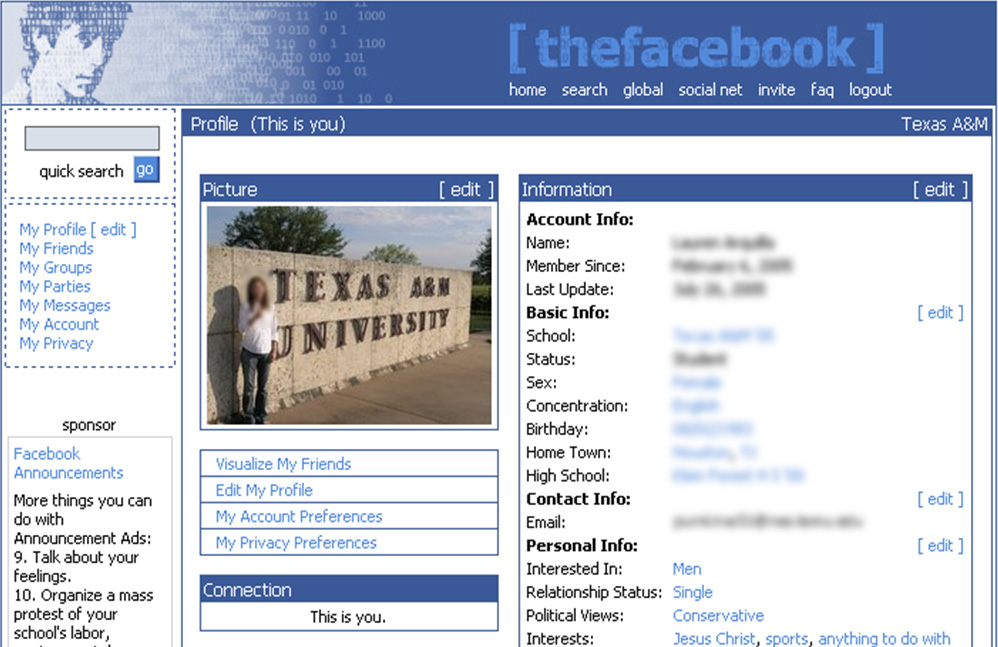
I watched The Social Network yesterday. It was my second time watching the Facebook-inspired biopic. It's a great flick, however true-to-life it was. The film is bringing even wider publicity to the social networking site -- originally called The Facebook as the movie accurately depicts -- and CEO Mark Zuckerberg.
Screenshot of Facebook's initial layout, The Facebook
It's a communication vehicle, a networking resource, and so much more. In the movie, after Facebook had taken over at Harvard University, they make reference to the term "facebook me." I guess it's today's version of, um, "look me up in the phone book." But it's definitely a sign of universal adoption, similar to Google's climb to the top. "Google it." Or Photoshop, which has become synonymous with photo editing. Becoming a verb is the ultimate goal for a company.

Users, all 500 million of them around the world, are spending more and more time on Facebook. At work, at home and on the go via smartphones. Even the term "on facebook" does not refer to www.facebook.com anymore with the adoption of Facebook application for smartphones and the new Facebook phone itself.
Mobile is taking over my life. I'm on my Droid all day. And night. I'll often be surfing the web on my Droid with my laptop right next to me. I use Facebook on my smartphone almost as much as I am on my laptop and my work PC.

I wrote some of this blog post on my Droid. Yep, with my recently installed Wordpress app. In fact I'm writing this sentence on it.

I've read more news on my Droid (my first smartphone) in the last six months than probably the previous six years with access to newspaper and TV. Smartphone news apps like New York Times, USA Today, CNET News, Engadget, NPR News, CBS News, Yahoo! News, The Huffington Post and many more. Text-based and videos. In some cases, the same news videos that air on TV.

What am I getting at? Mobile. The world is becoming increasingly mobile. And the brands and companies that move with that shift will prosper. While those that don't will have to play catch-up.

Smartphone users are on the rise, 60 percent higher at the end of 2010 than it was a year ago.  Smartphoners are ready to eclipse the number of feature phone (dumbphone) users. That should occur sometime in 2011.
In the three-month period between September of 2010 and December of 2010, nearly 25% of mobile subscribers accessed a social networking site.

Rockmelt web browser. Powered by Google's Chromium, Rockmelt is like Google Chrome with full Facebook integration (as well as Twitter). I'm typing in it right now. The browser window looks the same. Tabs, the same. But my Facebook friends are in a side bar to my left. Facebook status updates pop up at the bottom of the screen from time to time, telling me what's happening in my friend circle.

I can chat with my friends without opening a new tab, or without going to Facebook.com. I just click on a friend's name in the left panel and the chat bar slides open.

Below is a screenshot I took while composing this post. You can see my friends on the left panel.


Facebook application. The Facebook application on smartphones is a quicker, slimmer version of  facebook.com. It launches faster than opening a browser on your smartphone and is basically a mobile version of the website. You can navigate all of Facebook's features on the application, like the News Feed, your Profile, your Friends, Messages, Places, the new Groups feature, Events, Photos and Facebook Chat. Facebook chat on your mobile phone is a nice feature, essentially a free texting service. And an untitled photo stream, similar to the news feed but with only photos uploaded by your friends. And then there's Facebook's new messaging service.

The Facebook phone. Facebook itself is not building a phone, that we know of. But other manufacturers are building phones that integrate the social networking site into its phone (similar to Rockmelt's inclusion in its web browser). One Facebook phone manufacturer is INQ (pronounced "ink"). The company has actually introduced two versions of its Facebook phone, the Cloud Touch and the Cloud Q.
“We want to have every user in every market using Facebook– we’re investing in smartphones and at the same time as in mass market phones because we believe with great features and great integrations, every phone can become sociable.” - Henri Moissinac, Facebook's Head of Mobile Business
HTC (pronounced, um, HTC) is also developing a Facebook phone, set to be introduced this month according to reports. The phone will have a dedicated Facebook Button that will take users directly to Facebook. "It's one of HTC's main pushes for this year," a person familiar with HTC's strategy told Financial Times.
However the Facebook phones turn out,  one thing is for sure: this is only the beginning.
Facebook is integrating itself into every aspect of our lives. On the web, on our phones and on the go via status updates, photos, tagged friends and events.

Facebook's "Like" feature, as Zuckerberg likely envisioned, stretches all across the web, making Facebook the center of it all.

And we all know it's not over. Facebook is not done expanding, evolving and becoming even more entrenched in our personal and business lives. I, for one, welcome the intrusion.

My take on digital and social media

I was asked to guest lecture an advertising course at Penn State University on Monday, Jan. 24, 2011. In preparing my presentation, I figured I'd use this blog as my whiteboard. Kill two birds with one stone, as they say.

Besides I'm always looking for ways to be more efficient, like drinking and driving planning my work schedule in advance.

So here it is, the outline to my presentation, which will focus on digital media, dip into social media and center around technology including a few recently announced items from the Consumer Electronics Show (CES).

My take on social media

The most exciting aspect of social media or even digital media -- music, TV, internet -- is that we have no idea how cool our world will be tomorrow, how connected we'll be, how new gadgets will effect our lives.

The way Facebook  has impacted us, integrated itself into our everyday actions and has become part of our everyday lexicon has changed the world. Connected us like nothing before it. Facebook launched in 2004. Since its adoption, hundreds of other copy-cats have emerged. What will be the next Facebook? The next world-changing innovation?

Then take Twitter, created in 2006, is the hottest little thing next to Facebook. Twitter's micro-blogging service has exploded among celebrities and sports stars, has filled a niche that Facebook doesn't. Pro athletes are announcing moves on Twitter before the reporters have the story. Celebrity tweets are quoted daily in the news.

Twitter has successfully evolved into a full-fledged news outlet, from the sources themselves.

What to watch in digital media

Two trends to keep an eye on: 1) Music, particularly how we listen to radio at work, in the car and at home; 2) Television.

Music: Radio, Pandora & your Fridge.

Over the last 10 years, the way we listen to music has changed substantially. Terrestrial radio is still the most-listened to medium. Terrestrial radio reaches nearly 93 percent of people over the age of 12 in a given week. Some 240 million people listen to radio via the radio dial. Compare that to Sirius XM, which just hit 20 million subscribers. Pandora, which began in 2000, has 75 million subscribers.

But even the way we listen to good ol' terrestrial radio has changed. Local radio stations, like the one I work for, are streaming online and have mobile phone apps, in addition to the recent addition of FM Tuners on iPods and other mp3 players.

And that's just FM radio.

Pandora is making even bigger leaps away from its traditional home on the PC, on nearly every type of electronic device we own. In addition to the PC, Pandora is connected to smartphones, automobiles, tablets and televisions.

According to a published report from Advertising Age, more than 50 percent of Pandora listening is done on devices other than the PC.

Including a new device: refrigerators. That's right, the Fridge. Samsung has just announced a Wi-Fi enabled refrigerator with Pandora.

Pandora, by the way, is an advertising supported medium. Much like terrestrial radio, Pandora offers its services for free, then sells ads to all of its listeners. This free, ad-supported model is what has driven terrestrial radio since its first ad, and it's what has taken Pandora from near bankruptcy four years ago to nearly ubiquitous in media. It's also what will drive the change in TV.

Pandora does offer $3 monthly (or $36 annual) fee to stream its music commercial-free, but the majority of users opt for free ad-supported listening, considering it a fair trade-off.

One more thing on streaming radio. According to the Radio Advertising Bureau, streaming radio represents only 4 percent of radio listening. So the future of radio may be streaming, but it's not there yet.

Television: What's your favorite channel?

First of all, what is "TV"? Is it the product? The Show? Or is it the distribution vehicle, Comcast? DirecTV?

I say it's the product, the show. And I predict a big change on the horizon in the way we watch TV. We’ve already experienced the start of it with Netflix, Hulu, GoogleTV, Boxee Box, etc and devices like SlingBox, which slings your paid content to other sets and devices outside of your home. But I think this trend will explode in 2011 or early 2012. TV isn’t dead, it’s just evolving.

Television doesn’t live in box anymore. Well, it still kind of does, but that box is hooked up to the Internet. Connecting our HDTV sets to the world wide web syncs our Televisions to an array of programming and applications. Programming like Netflix, Hulu Plus and Vudu as well as applications (apps) that vary depending on the manufacturer, product and model. Samsung’s apps include Facebook, Twitter, YouTube, Pandora, Blockbuster, ESPN, AP, USAToday, Yahoo!, Skype, and many more, all on your TV.

Samsung, in my opinion, is leading the way in Internet Apps. Internet@TV, as Samsung calls it, is available on certain models of Samsung TVs and Samsung BluRay Players. Samsung's Internet@TV apps include: Netflix, Hulu Plus, Break, Blockbuster, Daily Motion, TED, Vudu, Social TV including Facebook & Twitter, AccuWeather, AP News, ESPN Score Center, Facebook, Twitter, Geek Squad (a Best Buy channel, one of the first sponsored apps), HSN, MLB.tv, Pandora, Samsung ESPN Next Level, Skype, Yahoo News, and more.

This shift, in the way we will someday watch TV, provides an opportunity similar to Pandora, ad-supported and relatively free to use. Hulu was one of the first to adopt the free, ad-supported content. And they've now extended that same plan to Hulu Plus.

The only difference being Netflix, Hulu Plus and internet apps require a device to stream the content to your television. So the cost is upfront. Netflix and Hulu Plus also have subscriptions, starting at $7.99 per month.

Netflix has yet to incorporate advertising. But it's doing quite well without it so far, leading the pack when it comes to at-home video streaming.

Internet apps are essentially TV Channels, like ABC, Fox or ESPN. Only they're on our schedule, not the networks.

Internet apps, including Netflix and Hulu Plus, are the future. They'll soon change TV forever.

Because a movement is slowly building. But consumers will still have to drive it.